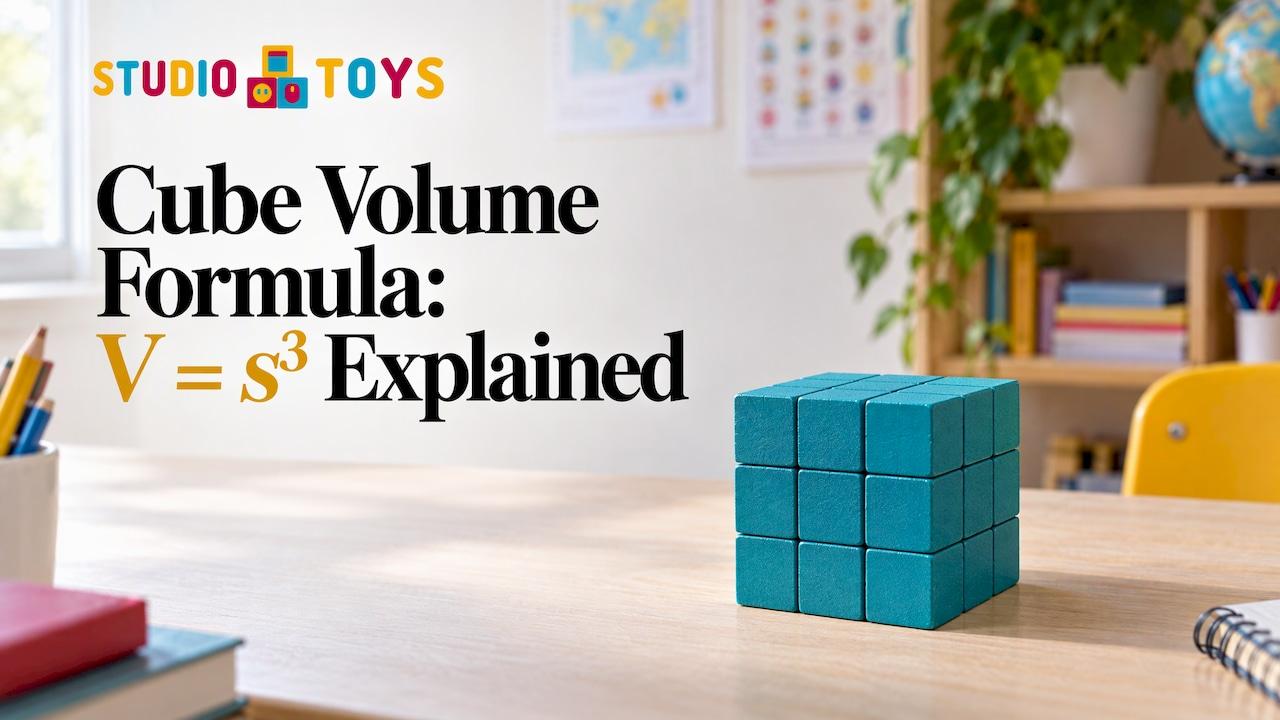
The equation for the volume of a cube is V = s³, where V is the volume and s is the length of one edge. You multiply the edge by itself three times: s × s × s. A cube with 3-inch edges holds 3 × 3 × 3 = 27 cubic inches. That is the whole formula, and the rest of this guide shows why it works, how to use it without slipping on units, and how to run it backward when you know the volume and need the edge. We built it for students, teachers, parents and anyone who likes seeing how a rule is made, not just memorizing it.
TL;DR
- Volume of a cube: V = s³ (edge × edge × edge), as OpenStax's geometric formulas table gives it.
- It is a special case of length × width × height, because all three measurements of a cube are the same.
- Always write the answer in cubic units: cm³, m³, in³, ft³.
- To find the edge from the volume, take the cube root: s = ∛V.
- A quick check: a 3 cm cube is 27 cm³, a 5 cm cube is 125 cm³, and a 10 cm cube is 1,000 cm³.
Table of Contents
- What the formula says
- Why the volume of a cube is the edge cubed
- How to find the volume of a cube, step by step
- Worked examples
- How volume grows when the edge grows
- Which units to use for volume
- Working backward: from volume to side length
- Cube volume versus other solids
- Common mistakes and how to avoid them
- Making cube volume stick
- Learn it with emoji and charts at Studio
- FAQ
- Sources
What the formula says
A cube is a solid with six identical square faces. Every edge has the same length, and every corner is a right angle. Because of that, one measurement describes the entire shape. You do not need a length, a width and a height. You need only s, the edge.
Volume is the amount of space inside a solid. Think of it as the number of small unit cubes, say 1 cm on each side, that would fill the shape with no gaps. The formula V = s³ counts those little cubes for you.
The small raised 3 is an exponent. It means "use the number as a factor three times." So s³ is not s × 3. This is the most common slip in homework: 4³ is 4 × 4 × 4 = 64, not 4 × 3 = 12.
You may see the formula written several ways. They all mean the same thing:
| Written as | How to read it |
|---|---|
| V = s³ | volume equals the side cubed |
| V = s × s × s | volume equals side times side times side |
| V = a³ | same formula, with a as the edge letter |
| V = l³ | same formula, with l for length |
| V = (length)³ | same formula, written in words |
The Open University's OpenLearn geometry course states it as length × length × length, which equals (length)³. Different books pick different letters, and none of them changes the math.
Why the volume of a cube is the edge cubed
The formula makes sense once you build a cube in your head, one layer at a time.
Take a cube with 3-unit edges. Look at the bottom layer. It is a flat square, 3 units by 3 units, so it holds 3 × 3 = 9 unit cubes. That is the same calculation as the area of a square.
Now stack layers. The cube is 3 units tall, so you stack 3 identical layers. Three layers of 9 cubes each makes 27 cubes in total.
So the logic runs like this:
- Base area = s × s (the edge times itself)
- Number of layers = s (the height equals the edge)
- Volume = base area × layers = s × s × s = s³
That is the same idea as the general rule for boxes. NASA's volume page explains that a rectangular prism with dimensions a, b and h has volume V = a × b × h, and that when all the sides are equal to a, the equation becomes V = a³. A cube is just a box where length, width and height happen to match.
This also explains the name. We say "squared" for a power of 2 because s² gives the area of a square, and "cubed" for a power of 3 because s³ gives the volume of a cube.
How to find the volume of a cube, step by step
The same four steps work for any cube, whether the edge is 2 cm or 2 miles.
Step 1: Measure or read the edge
Find the length of one edge. In a word problem it may be called "side," "edge" or "side length." Because all edges of a cube are equal, one measurement is enough. If a problem gives you two different lengths, the shape is a rectangular box, not a cube, and you need the length × width × height version.
Step 2: Write the formula
Write V = s³ before you put in numbers. It keeps your work readable and makes it easy for a teacher (or you, later) to see where a mistake crept in.
Step 3: Substitute and multiply
Replace s with the edge length and multiply it by itself three times. Do it in two moves if that is easier: first s × s, then multiply that result by s again.
Step 4: Add the cubic unit
If the edge was in centimeters, the volume is in cubic centimeters (cm³). If it was in feet, the answer is in cubic feet (ft³). Skipping this step is the second most common way to lose marks.
Worked examples
Working a handful of cubes by hand builds a feel for how fast volume grows.
Example 1: a 3 cm cube. V = 3³ = 3 × 3 × 3 = 27 cm³. BBC Bitesize works this exact case as 3³ = 27.
Example 2: a 5 cm cube. V = 5³ = 5 × 5 × 5 = 125 cm³. This is also the example BBC Bitesize uses for a 5 cm edge.
Example 3: a 9 m cube. V = 9³ = 9 × 9 × 9 = 729 m³. The same page gives this result for a 9 m edge.
Example 4: a 7 inch cube. V = 7³ = 7 × 7 × 7 = 343 in³. Do it in two moves: 7 × 7 = 49, then 49 × 7 = 343.
Example 5: a decimal edge. A cube with a 2.5 cm edge has V = 2.5 × 2.5 × 2.5. First 2.5 × 2.5 = 6.25, then 6.25 × 2.5 = 15.625 cm³. A calculator is handy here, and the exponent key (often labeled x^y or ^) lets you type 2.5 ^ 3.
Example 6: a real-world box. A square moving box that is 2 feet on every edge has V = 2³ = 8 ft³. Doubling the edge from 1 foot to 2 feet did not double the space, it multiplied it by eight.
That last point deserves a closer look.
How volume grows when the edge grows
Because the edge is cubed, small changes in the edge cause big changes in volume. This is why a table of cubes is worth knowing.
| Edge (s) | Volume (s³) |
|---|---|
| 1 | 1 |
| 2 | 8 |
| 3 | 27 |
| 4 | 64 |
| 5 | 125 |
| 6 | 216 |
| 7 | 343 |
| 8 | 512 |
| 9 | 729 |
| 10 | 1,000 |
Two patterns are useful on tests:
- Double the edge, get 8 times the volume. Triple the edge and you get 27 times the volume, since 3³ = 27.
- Halve the edge, get one eighth of the volume. If each side of a cube is cut to half, the new volume is 1/8 of the original. This is a classic question in textbooks, and the answer is exactly why the exponent matters.
Parents helping with homework can try this with sugar cubes or building blocks. Build a 2 × 2 × 2 cube from 8 blocks, then a 3 × 3 × 3 cube from 27, and let the child count. Seeing 27 blocks is more convincing than any explanation.
Which units to use for volume
Volume is always in cubic units, because you multiplied three lengths together, and each one carried a unit. Multiplying cm × cm × cm gives cm³.
The OpenLearn course notes that volume is commonly measured in cubic centimeters (cm³) or cubic meters (m³). In the United States you will also meet customary units:
| Edge measured in | Volume is in | Written as |
|---|---|---|
| millimeters | cubic millimeters | mm³ |
| centimeters | cubic centimeters | cm³ |
| meters | cubic meters | m³ |
| inches | cubic inches | in³ |
| feet | cubic feet | ft³ |
| yards | cubic yards | yd³ |
Three rules keep unit mistakes away:
- Use one unit for the edge. Convert before you cube, never after. If an edge is given as 2 feet 6 inches, turn it into 30 inches (or 2.5 feet) first.
- Do not mix cubic and square units. Area is in squared units (cm²) and volume is in cubed units (cm³). A cube has both: a surface area in square units and a volume in cubic units.
- Cube the unit too. Converting cubic units is not the same as converting lengths. One meter is 100 cm, but one cubic meter is 100 × 100 × 100 = 1,000,000 cm³, not 100 cm³.
That third rule trips up many students. If you have a volume in cm³ and want m³, divide by a million, not by a hundred. A handy check: engineering unit tables list conversion factors between cubic centimeters, cubic inches, cubic feet and more when you need to move between systems.
Working backward: from volume to side length
Sometimes you know the volume and need the edge. Since cubing and taking a cube root undo each other, the reverse formula is:
s = ∛V
The symbol ∛ means "the number that, multiplied by itself three times, gives V." BBC Bitesize shows this with ∛343 = 7 mm, which recovers a 7 mm edge from a volume of 343 mm³.
Here is the routine:
- Write s = ∛V.
- Put in the volume.
- Find the cube root, using the table above or a calculator. On many calculators you type the volume, then use the ∛ key, or raise it to the power 1/3.
- Write the edge in linear units (cm, not cm³).
Example: A cube has a volume of 64 cm³. Then s = ∛64 = 4 cm, since 4 × 4 × 4 = 64.
Example: A cube has a volume of 1,000 in³. Then s = ∛1,000 = 10 in.
If the volume is not a perfect cube, estimate. A volume of 100 cm³ falls between 64 (edge 4) and 125 (edge 5), so the edge is between 4 and 5 cm, a little over 4.6 cm. A calculator gives the precise figure.
Cube volume versus other solids
Students often meet the cube formula next to others, and the search results around this topic show readers asking about them. Here is how they line up.
| Solid | Volume formula | What the letters mean |
|---|---|---|
| Cube | V = s³ | s = edge |
| Rectangular prism (box) | V = l × w × h | length, width, height |
| Sphere | V = (4/3)πr³ | r = radius |
The l × w × h formula is the parent of the cube formula. Set l = w = h = s and you get s × s × s. This is why you can use the box formula on a cube and still get the right answer, though the shortcut is faster.
The sphere has a radius cubed too, which is why its volume also climbs quickly as it grows. The cube is the best place to learn the pattern because the numbers stay whole and you can picture every little block.
Common mistakes and how to avoid them
- Multiplying by 3 instead of cubing. 6³ is 216, not 18. Say "six times six times six" out loud while you write it.
- Squaring instead of cubing. 6² = 36 is the area of one face. Check that your answer is bigger than the face area when the edge is greater than 1.
- Forgetting the unit or writing a flat one. The answer to a volume question has a cubed unit. "27 cm" is wrong, "27 cm³" is right.
- Mixing units. An edge of 1 foot and 3 inches must become 15 inches (or 1.25 feet) before cubing.
- Using the wrong shape. If the three measurements differ, it is a rectangular prism. Use l × w × h.
- Confusing volume with surface area. Surface area of a cube is 6s², since there are six square faces. Volume tells you how much fits inside, surface area tells you how much wrapping paper you need.
A sensible self-check: round the edge to the nearest whole number, cube it in your head and see if your answer is close. A 4.9 cm edge should give a result near 125 cm³, not near 15.
Making cube volume stick
Formulas stay in memory when you attach them to something you can see. Here are ideas for each kind of learner.
Students: Build the table of cubes from 1 to 10 once, on paper, then cover it and recite. Pair each cube with a picture: a die is a small cube with an edge of about 1.6 cm, so it is a good prop for imagining 1³.
Teachers: Give each group 27 linking cubes and ask them to prove why a 3 × 3 × 3 shape has volume 27 before you reveal the formula. Then ask what happens if the edge doubles. Students who discover the answer of 8 themselves tend to remember it.
Parents: Use the kitchen. Ask your child to estimate how many 1-inch blocks fit in a small square box, then measure and compute. Real objects turn an abstract exponent into a guess that can be right or wrong, and that is more fun.
Lifelong learners: Try the "why" version. Ask yourself why volume scales with the cube of length, and then notice the same pattern in the world: why a big animal needs much more food than a small one, or why a cargo container holds so much more than a shoebox.

Learn it with emoji and charts at Studio
If you learn better from pictures than from symbols, Studio is a free online encyclopedia that explains topics with emoji-enhanced text and visual charts. It is made for students, teachers, parents and curious adults who find plain reference pages dull. You can browse topics across many subjects at Studio, and use the visual approach for geometry, from cubes to the other shapes in this guide.

Teachers can bring the same style into a lesson, and parents can open a page with a child who needs a livelier way in than a textbook paragraph.
FAQ
What is the formula for the volume of a cube?
The formula is V = s³, where s is the length of one edge. You multiply the edge by itself three times. For example, a cube with a 4 cm edge has a volume of 4 × 4 × 4 = 64 cm³.
What is the volume of a cube with 3 cm sides?
It is 27 cm³, because 3³ = 3 × 3 × 3 = 27. BBC Bitesize works through this same calculation. Remember to write the unit as cubic centimeters.
Is the cube formula the same as length × width × height?
Yes, it is a special case. A box has volume length × width × height, and in a cube all three are equal to the edge s. That turns the product into s × s × s, which is s³, as NASA's explanation of volume describes.
How do you find the edge of a cube from its volume?
Take the cube root of the volume: s = ∛V. A cube with a volume of 343 mm³ has an edge of ∛343 = 7 mm. Give the answer in a length unit, not a cubic one.
What units do you use for the volume of a cube?
Use cubic units that match the edge: cm³ for centimeters, m³ for meters, in³ for inches and ft³ for feet. Convert all lengths to one unit before you cube them, so the answer stays consistent.